Quick Verdict: Is 50 Mbps Good for Gaming?
| Factor | Verdict | Details |
|---|---|---|
| Online Multiplayer | Generally Good | For most standard online multiplayer games (FPS, MOBA, MMORPGs), 50 Mbps download and typical 5-10 Mbps upload is sufficient, provided your ping (latency) is low. |
| Game Downloads | Decent, but can take time | A 50 GB game can take around 2.5 hours to download. Smaller updates are quick. Larger game files (100+ GB) will require significant waiting. |
| Cloud Gaming | Borderline/Insufficient | Services like GeForce NOW or Xbox Cloud Gaming often recommend 50-75 Mbps minimum for 1080p, and more for 4K. 50 Mbps might offer a playable but not optimal experience, especially with other network activity. |
| Multiple Users/Devices | Can struggle | If multiple people are streaming 4K video, downloading large files, or video conferencing simultaneously while you game, 50 Mbps can quickly become saturated, leading to lag and high ping. |
| Streaming while Gaming | Possible, but risky | A single 1080p stream typically uses 5-8 Mbps upload. While 50 Mbps download is fine, your upload speed (usually 5-10 Mbps with a 50 Mbps plan) might be insufficient for high-quality streaming while playing, leading to dropped frames or buffering for your viewers. |
| Overall Recommendation | Good for solo/light gaming, consider upgrade for heavy use or cloud gaming. | For a single gamer who primarily plays online multiplayer, 50 Mbps is often perfectly adequate. However, if you live in a multi-user household, frequently download huge games, stream your gameplay, or heavily rely on cloud gaming services, you may want to consider a faster plan (100-200+ Mbps) for a smoother, more reliable experience. |
In the fast-paced world of online gaming, internet speed is often touted as the be-all and end-all of performance. You hear numbers thrown around – 100 Mbps, 500 Mbps, even 1 Gigabit – and it’s easy to feel like anything less is a ticket to "lag city." But what about a more modest speed like 50 Mbps? Is this widely available and often more affordable tier truly "good for gaming," or will it leave you frustratingly behind the curve?
At TechCalc, we're all about demystifying tech specs to help you make informed decisions. This comprehensive guide will break down exactly what 50 Mbps offers, where it excels, and where it might fall short for your gaming habits. We'll look beyond just download numbers and dive into the critical factors that truly impact your online experience, from latency to network congestion.
Understanding Internet Speed for Gaming: It's More Than Just Mbps
Before we declare 50 Mbps a gaming champion or a digital dinosaur, let's clarify what those numbers actually mean and which aspects of your internet connection genuinely matter for gaming.
Mbps (Megabits per Second): This is the unit used to measure your internet speed. It tells you how much data can be transferred to (download) or from (upload) your device each second.
- Download Speed: How fast data comes to your computer. Crucial for downloading games, updates, streaming video, and receiving game data.
- Upload Speed: How fast data goes from your computer. Essential for sending your commands to game servers, voice chat, and streaming your gameplay to platforms like Twitch.
While 50 Mbps refers to your download speed, it's important to remember that most internet plans are asymmetrical. This means your upload speed will typically be significantly lower than your download speed (e.g., a 50 Mbps download plan might only offer 5-10 Mbps upload).
Latency (Ping): The Unsung Hero of Gaming Far more critical than raw bandwidth for most online multiplayer games is latency, often referred to as "ping." Ping is the time it takes for a data packet to travel from your device to the game server and back again, measured in milliseconds (ms).
- Low Ping (e.g., 20-50ms): Ideal. Your actions register almost instantly on the server, resulting in a smooth, responsive experience.
- Moderate Ping (e.g., 50-100ms): Playable for many games, but you might notice a slight delay in fast-paced titles.
- High Ping (e.g., 100ms+): Detrimental. Your character might "teleport," shots won't register, and you'll experience significant lag, making competitive gaming nearly impossible.
Think of it this way: Bandwidth (Mbps) is the width of a highway, determining how many cars (data packets) can travel at once. Latency (ping) is the speed limit on that highway. A wide highway with a low speed limit (high latency) is still going to be slow, even if it can handle a lot of traffic.
Jitter: Jitter refers to the variation in latency over time. If your ping constantly fluctuates (e.g., 30ms, then 80ms, then 40ms), this "jitter" can be just as disruptive as consistently high ping, leading to inconsistent gameplay.
Packet Loss: This occurs when data packets fail to reach their destination. Even with good speed and ping, packet loss can cause missing information, leading to stuttering, disconnects, and unresponsiveness.
Is 50 Mbps "Enough" for Gaming? The Core Question
For the vast majority of online multiplayer gaming (think Fortnite, Call of Duty, League of Legends, World of Warcraft), a 50 Mbps download speed is generally sufficient. These games are surprisingly efficient with bandwidth during actual gameplay. They prioritize low latency and small, frequent data packets over large, continuous downloads.
Here's why 50 Mbps often works:
- Gameplay data is small: Playing an online game typically only uses 0.1 Mbps to 1 Mbps of download and upload bandwidth. This is because the server only needs to send information about character positions, actions, and game state, not high-resolution video streams.
- Focus on Latency: As discussed, latency is key. A 50 Mbps connection with a stable 30ms ping will always outperform a 500 Mbps connection with a fluctuating 150ms ping for competitive gaming.
However, "enough" is a subjective term that heavily depends on your specific gaming habits and household environment.
The Numbers Game: What 50 Mbps Can Really Do
Let's break down the practical implications of a 50 Mbps connection for various gaming-related activities.
1. Game Downloads and Updates: This is where raw download speed becomes most noticeable. Modern games are massive, often exceeding 100 GB. A 50 Mbps connection translates to approximately 6.25 MB per second (Megabytes, not Megabits).
Here's a look at typical download times for various game sizes:
| Game Size (GB) | Download Time (50 Mbps) | Download Time (100 Mbps) | Download Time (200 Mbps) |
|---|---|---|---|
| 5 GB | ~13 minutes | ~6.5 minutes | ~3.25 minutes |
| 10 GB | ~26 minutes | ~13 minutes | ~6.5 minutes |
| 25 GB | ~1 hour, 5 minutes | ~32.5 minutes | ~16.25 minutes |
| 50 GB | ~2 hours, 10 minutes | ~1 hour, 5 minutes | ~32.5 minutes |
| 100 GB | ~4 hours, 20 minutes | ~2 hours, 10 minutes | ~1 hour, 5 minutes |
| 150 GB | ~6 hours, 30 minutes | ~3 hours, 15 minutes | ~1 hour, 37 minutes |
Note: These are theoretical maximums. Actual speeds can vary due to server load, network congestion, and other factors. You can use our download time calculator to estimate more precisely.
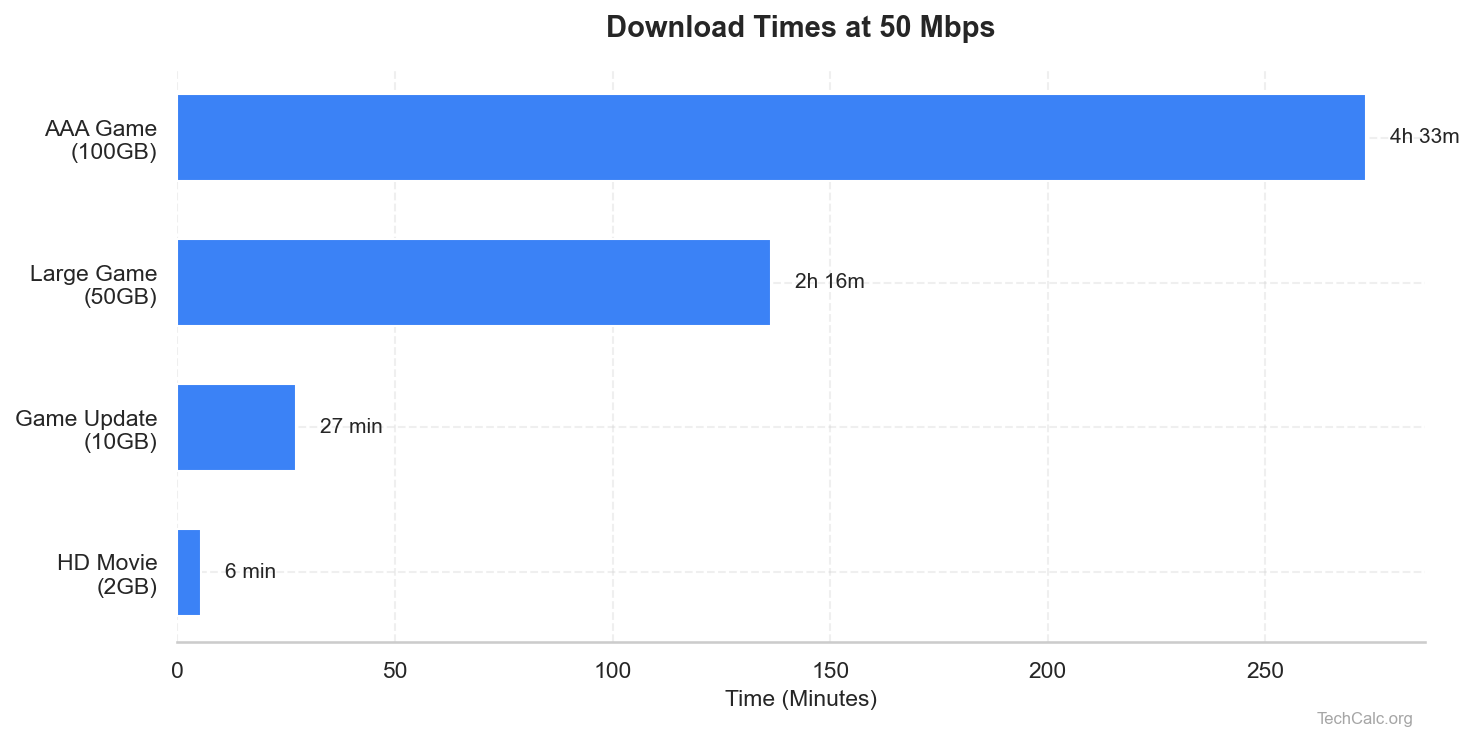
As you can see, downloading a brand-new, hefty title on a 50 Mbps connection can take a few hours. This isn't a deal-breaker if you plan ahead or download overnight, but it's certainly not instantaneous. Smaller updates, however, will typically be very quick.
2. Upload Speeds (for Streaming & Voice Chat): A 50 Mbps plan typically comes with an upload speed of 5-10 Mbps.
- Voice Chat (Discord, in-game chat): Uses very little bandwidth (tens of kilobits per second). Even 1 Mbps upload is more than enough for crystal-clear voice communication.
- Streaming Gameplay (Twitch, YouTube): This is where upload speed becomes critical.
- 720p @ 30fps: Recommended upload around 2.5 - 4 Mbps.
- 1080p @ 30fps: Recommended upload around 3.5 - 5 Mbps.
- 1080p @ 60fps: Recommended upload around 4.5 - 6 Mbps.
If your 50 Mbps plan offers 5-10 Mbps upload, you might be able to stream at 720p or even 1080p @ 30fps, provided you're not doing anything else bandwidth-intensive. However, if your upload is closer to the 5 Mbps mark, trying to stream at higher quality or 60fps while gaming could easily max out your upload, leading to dropped frames for your viewers and potentially impacting your in-game ping.
Gaming Performance Factors Beyond Speed
Even with a 50 Mbps connection, several other elements can significantly influence your gaming experience:
- Latency (Ping): As emphasized, this is paramount. Your speed could be 1 Gbps, but if your ping is consistently high due to your distance from the server, poor routing, or local network issues, your gaming will suffer.
- Router Quality & Placement: An old, outdated, or poorly placed router can severely bottleneck your connection, even if your ISP delivers 50 Mbps to your home. Ensure your router is relatively modern, supports Wi-Fi 5 (802.11ac) or Wi-Fi 6 (802.11ax), and is centrally located.
- Wired vs. Wireless (Ethernet vs. Wi-Fi): For gaming, a wired Ethernet connection is almost always superior to Wi-Fi. It provides a more stable connection, lower latency, and less susceptibility to interference from other devices or network congestion. If you're serious about gaming, connect your PC or console directly to your router with an Ethernet cable.
- Number of Users & Devices: This is a major factor for 50 Mbps. If you're the only one using the internet, 50 Mbps is generous. However, if multiple family members are simultaneously streaming 4K video, downloading large files, video conferencing, or browsing heavily, that 50 Mbps will be split, and your gaming experience will suffer.
- Type of Game:
- Casual/Turn-Based (e.g., Chess, Card Games, Minecraft (non-competitive)): Very low requirements. 50 Mbps is overkill.
- MMORPGs (e.g., WoW, FFXIV): Moderate requirements. 50 Mbps is generally good, as these games are less sensitive to micro-lag than FPS titles.
- First-Person Shooters (FPS) & Battle Royale (e.g., CoD, Apex Legends, Valorant): Highly sensitive to latency. 50 Mbps download is sufficient, but stable low ping and adequate upload (for hit registration) are critical.
- Real-Time Strategy (RTS) & MOBAs (e.g., StarCraft II, League of Legends, Dota 2): Similar to FPS, stable low ping is more important than raw download speed. 50 Mbps is very good.
- Cloud Gaming (e.g., GeForce NOW, Xbox Cloud Gaming): This is the exception. Cloud gaming streams the entire game to you as a video feed and sends your inputs back. This requires significantly more consistent bandwidth and extremely low latency. 50 Mbps is often the minimum recommended for 1080p, and higher speeds (75-100+ Mbps) are preferred for a truly smooth experience, especially for 4K.
When 50 Mbps Might Fall Short
While 50 Mbps is generally good, there are specific scenarios where it might not meet your expectations:
- Multi-User Households with High Demand: If two people are streaming Netflix in 4K (approx. 25 Mbps each), and a third person tries to download a new game, the 50 Mbps connection will be completely saturated, leading to buffering and lag for everyone.
- Large Game Downloads + Active Use: Trying to download a 100 GB game while someone else is video conferencing or streaming will be a slow and frustrating experience.
- Heavy Cloud Gaming: As mentioned, 50 Mbps often struggles to provide a consistently flawless cloud gaming experience, especially if other devices are active. You might experience input lag, visual artifacts, or resolution drops.
- Simultaneous High-Quality Streaming & Gaming: If you want to stream your gameplay to Twitch at 1080p 60fps while playing, your upload speed (typically 5-10 Mbps on a 50 Mbps plan) might be insufficient, causing dropped frames for your viewers or affecting your in-game performance.
- Frequent Large Game Updates: If you play many different games that frequently receive multi-gigabyte updates, you'll spend a fair amount of time waiting for them to download.
Optimizing Your 50 Mbps Connection for Gaming
If 50 Mbps is your current speed, or you're considering it, here's how to maximize its potential for gaming:
- Use an Ethernet Cable: This is the single most impactful step. A direct wired connection reduces latency, eliminates Wi-Fi interference, and provides a more stable link to your router.
- Prioritize Gaming Traffic (QoS): Many modern routers have Quality of Service (QoS) settings. Enable this and prioritize your gaming device or specific game traffic. This tells your router to send gaming data first, even if other devices are using the network.
- Close Background Applications: Make sure no other programs on your gaming device are hogging bandwidth (e.g., cloud storage syncing, large downloads, streaming services playing in the background).
- Update Router Firmware: Keep your router's software up to date. Manufacturers often release updates that improve performance and security.
- Optimize Router Placement: If you must use Wi-Fi, place your router in a central location, away from obstructions and other electronics that might cause interference.
- Limit Other Network Activity: During intense gaming sessions, ask household members to temporarily pause large downloads or 4K streaming if you notice performance issues.
- Run an Internet Speed Test: Regularly check your actual speeds using a reliable tool like the TechCalc internet speed test to ensure you're getting what you pay for. Test both download and upload, and crucially, your ping to various servers.
Comparing 50 Mbps to Other Speeds
To put 50 Mbps into perspective, let's look at how it compares to common internet tiers for various activities.
| Activity | 25 Mbps (Basic) | 50 Mbps (Good Standard) | 100 Mbps (Enhanced) | 200 Mbps (High-Performance) |
|---|---|---|---|---|
| Online Gaming (Single) | Good (if low ping) | Excellent | Excellent | Excellent |
| Online Gaming (Multi-user) | Borderline | Good | Excellent | Excellent |
| 4K Video Streaming | Single stream only | 1-2 simultaneous streams | 3-4 simultaneous streams | 5+ simultaneous streams |
| Cloud Gaming (1080p) | Struggles/Poor | Borderline/Playable (solo) | Good/Excellent | Excellent |
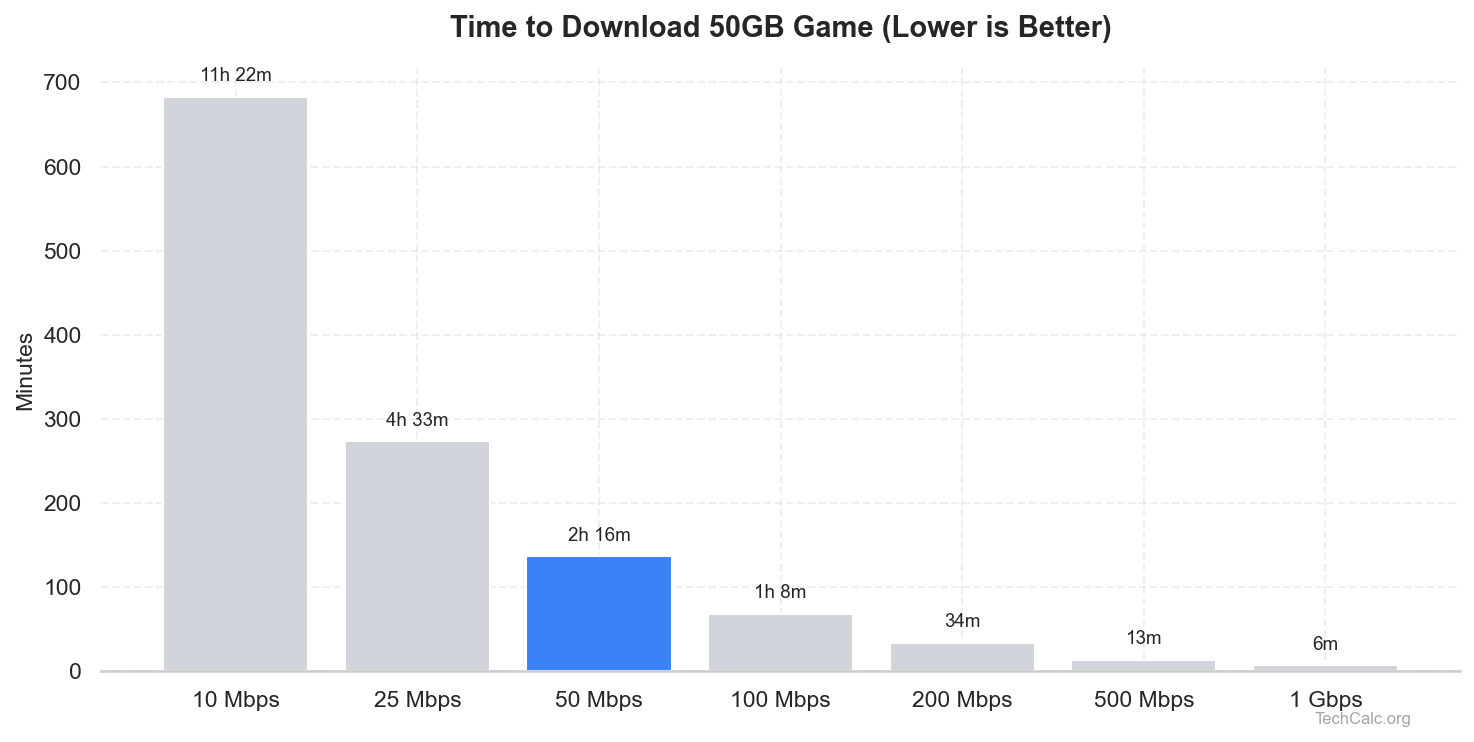
| Large Game Downloads | Very slow (4-6+ hours for 50GB) | Decent (2-3 hours for 50GB) | Fast (1-1.5 hours for 50GB) | Very Fast (30-45 min for 50GB) |
| Video Conferencing | Good (1-2 users) | Excellent (3-5 users) | Excellent (5+ users) | Excellent (Many users) |
| Simultaneous Activities | Limited | Moderate | Good | Excellent |
| Typical Upload Speed | 3-5 Mbps | 5-10 Mbps | 10-20 Mbps | 20-40 Mbps |
From the table, it's clear that 50 Mbps hits a sweet spot for many. It moves beyond the limitations of basic 25 Mbps plans for multi-user scenarios and offers a significant leap in download times, without the often-higher cost of 100 Mbps or 200 Mbps plans.
Cloud Gaming: A Special Case
It's worth reiterating that cloud gaming services like NVIDIA GeForce NOW, Xbox Cloud Gaming, and Amazon Luna have different requirements than traditional online multiplayer. Because the game is rendered on a remote server and streamed to your device as a video, it demands both high, consistent download speeds and extremely low, stable latency.
- NVIDIA GeForce NOW: Recommends 15 Mbps for 720p at 60fps and 25 Mbps for 1080p at 60fps. For 4K, significantly more is needed.
- Xbox Cloud Gaming: Recommends a minimum of 20 Mbps for a good experience.
While 50 Mbps meets the minimum for 1080p for many services, it leaves little headroom for other network activity. If you're serious about cloud gaming, especially at higher resolutions or with multiple users, aiming for 75-100 Mbps or more is highly advisable to prevent visual quality degradation, input lag, and stuttering.
Conclusion: 50 Mbps – A Solid Contender, But Know Your Limits
So, is 50 Mbps good for gaming? For the majority of single-player online gaming, where low latency is prioritized over raw download speed, yes, 50 Mbps is generally good and often perfectly sufficient. You'll be able to play most competitive titles without noticeable lag, provided your ping is stable and low. Voice chat will be crystal clear, and browsing the web or streaming video on a single device simultaneously won't be an issue.
However, 50 Mbps starts to show its limitations when:
- You live in a busy household with multiple simultaneous internet users.
- You frequently download massive game files (100 GB+).
- You plan to stream your gameplay at high quality (1080p 60fps).
- You heavily rely on cloud gaming services for the best experience.
For a single gamer or a household with light internet usage, 50 Mbps offers an excellent balance of performance and cost. If you tick any of the "limitations" boxes, consider a step up to 100 Mbps or 200 Mbps for a truly uncompromised gaming and internet experience. Ultimately, the "best" speed is the one that comfortably supports your unique digital lifestyle.