While the dream of a true 4K OLED ultrawide monitor is closer than ever, the reality is a bit more nuanced. Yes, models are emerging, but a genuine 4K (3840x2160) resolution combined with an ultrawide aspect ratio (like 21:9 or 32:9) is exceptionally rare. Most monitors marketed as '4K ultrawide' often refer to resolutions like 5120x2160 (5K2K) or even 3440x1440, which, while high-resolution, aren't technically 4K in the traditional sense. The real catch lies in pixel density and understanding what '4K ultrawide' truly means for your viewing experience, especially when comparing it to standard 16:9 4K displays.
⚡ Quick Verdict:
- ✅ Yes for incredible visuals, deep blacks, and immersive experiences if you choose carefully.
- ⚠️ Maybe if you're expecting traditional 3840x2160 4K resolution in ultrawide; most are 5K2K or 3440x1440.
- ❌ No if budget is your primary concern, or if you prioritize pixel density above all else on a very large screen.
- 👉 Key Factor: Understand the exact resolution (e.g., 5120x2160 vs. 3840x2160) and its impact on pixel density (PPI).
What Exactly is a 4K OLED Ultrawide Monitor?
Breaking down the term "4K OLED ultrawide monitor" helps clarify why it's such a sought-after, yet complex, product category. Each component — 4K, OLED, and ultrawide — brings significant advantages, but their combination presents manufacturing and resolution challenges.
Understanding "4K" in the Ultrawide Context
Traditionally, "4K" refers to a resolution of 3840x2160 pixels, also known as UHD (Ultra High Definition). This resolution maintains a standard 16:9 aspect ratio, common for TVs and many desktop monitors. When we talk about "4K" in an ultrawide format, things get tricky. An ultrawide monitor typically has an aspect ratio of 21:9, 32:9, or even 32:10.
To maintain the "4K" pixel height of 2160, an ultrawide monitor would need a significantly wider horizontal pixel count. For a 21:9 aspect ratio, this would mean a resolution of approximately 5040x2160 pixels. For a 32:9 aspect ratio, it would be around 7680x2160 pixels. However, most monitors marketed as "4K ultrawide" typically feature resolutions like 5120x2160 (often called 5K2K or UW5K) or even 3440x1440. While 5120x2160 offers more pixels than a standard 4K display, it's not the same pixel count or aspect ratio as a 16:9 4K panel. And 3440x1440, while a popular ultrawide resolution, has significantly fewer pixels than true 4K. It's crucial to check the exact pixel count, not just the marketing label.
The Allure of OLED
OLED (Organic Light-Emitting Diode) technology is renowned for its superior picture quality. Unlike LCD panels that rely on a backlight, each pixel in an OLED display emits its own light. This allows for:
- Perfect Blacks: Pixels can turn completely off, resulting in infinite contrast and truly deep blacks.
- Vibrant Colors: OLEDs offer exceptional color accuracy and saturation.
- Instant Response Times: Near-instant pixel response times virtually eliminate motion blur, making them ideal for fast-paced gaming.
- Wide Viewing Angles: Colors and contrast remain consistent even when viewed from extreme angles.
These characteristics make OLED displays highly desirable for both immersive gaming and professional content creation, where visual fidelity is paramount.
Why Ultrawide?
Ultrawide monitors offer an expanded horizontal field of view compared to traditional 16:9 displays. This wider canvas provides several benefits:
- Immersive Gaming: The extended peripheral vision can draw you deeper into games, particularly racing sims, flight sims, and open-world titles.
- Enhanced Productivity: More screen real estate allows for multiple windows to be open side-by-side without overlapping, reducing the need for multiple monitors or constant alt-tabbing.
- Cinematic Experience: Watching movies formatted in native ultrawide aspect ratios (like 2.35:1 or 2.39:1) fills the screen without black bars, providing a more cinematic view.
The combination of these three elements – high resolution, stunning OLED visuals, and an expansive ultrawide format – creates a compelling, albeit technologically challenging, display category.
Is There a 4K OLED Ultrawide Monitor?
The short answer is: yes, but it depends on your definition of 4K. As of 2026, the market for a true 4K OLED ultrawide monitor (meaning a 21:9 or 32:9 display with a vertical resolution of 2160 pixels and a horizontal resolution that matches the 4K pixel density for that aspect ratio) is still very niche. Most high-resolution ultrawide OLEDs you'll find are either 5120x2160 (5K2K) or 3440x1440.
For example, models like the LG 40WP95C-W, while stunning and often referred to loosely as "4K ultrawide," actually feature a 5120x2160 resolution. This is technically a "5K2K" resolution, offering more pixels than a standard 4K (3840x2160) screen but in a wider aspect ratio. The "2160" vertical pixel count aligns with 4K, but the horizontal count is significantly higher, making it a different beast.
More recently, QD-OLED (Quantum Dot OLED) technology has brought incredible vibrancy and brightness to the ultrawide market. Monitors like the Dell Alienware AW3425DW and the MSI MPG 491CQP QD-OLED are prime examples. However, even these cutting-edge displays typically offer resolutions like 3440x1440 (for 34-inch models) or 5120x1440 (for 49-inch super ultrawides). While these are fantastic resolutions, they do not have the 2160 vertical pixel count that defines traditional 4K.
The challenge lies in manufacturing large OLED panels with such high pixel counts and specific ultrawide aspect ratios. Panel production is complex and costly, and manufacturers often prioritize standard 16:9 4K OLED panels (like the popular 27-inch and 32-inch 4K OLEDs) due to higher demand and easier production scalability.
Here's a look at some popular "high-resolution" ultrawide OLED monitors and their actual specifications:
| Monitor Model (Example) | Panel Technology | Resolution (W x H) | Aspect Ratio | Approximate Size | PPI (calculated) |
|---|---|---|---|---|---|
| Dell Alienware AW3425DW | QD-OLED | 3440x1440 | 21:9 | 34 inches | 110 PPI |
| MSI MPG 491CQP QD-OLED | QD-OLED | 5120x1440 | 32:9 | 49 inches | 109 PPI |
| LG 40WP95C-W | IPS (not OLED) | 5120x2160 | 21:9 | 40 inches | 140 PPI |
| Hypothetical 4K UW OLED | OLED | 5040x2160 | 21:9 | 40 inches | 140 PPI |
| Standard 4K (16:9) | N/A | 3840x2160 | 16:9 | 32 inches | 137 PPI |
Note: PPI calculations are approximate and can be precisely determined using our PPI Calculator.
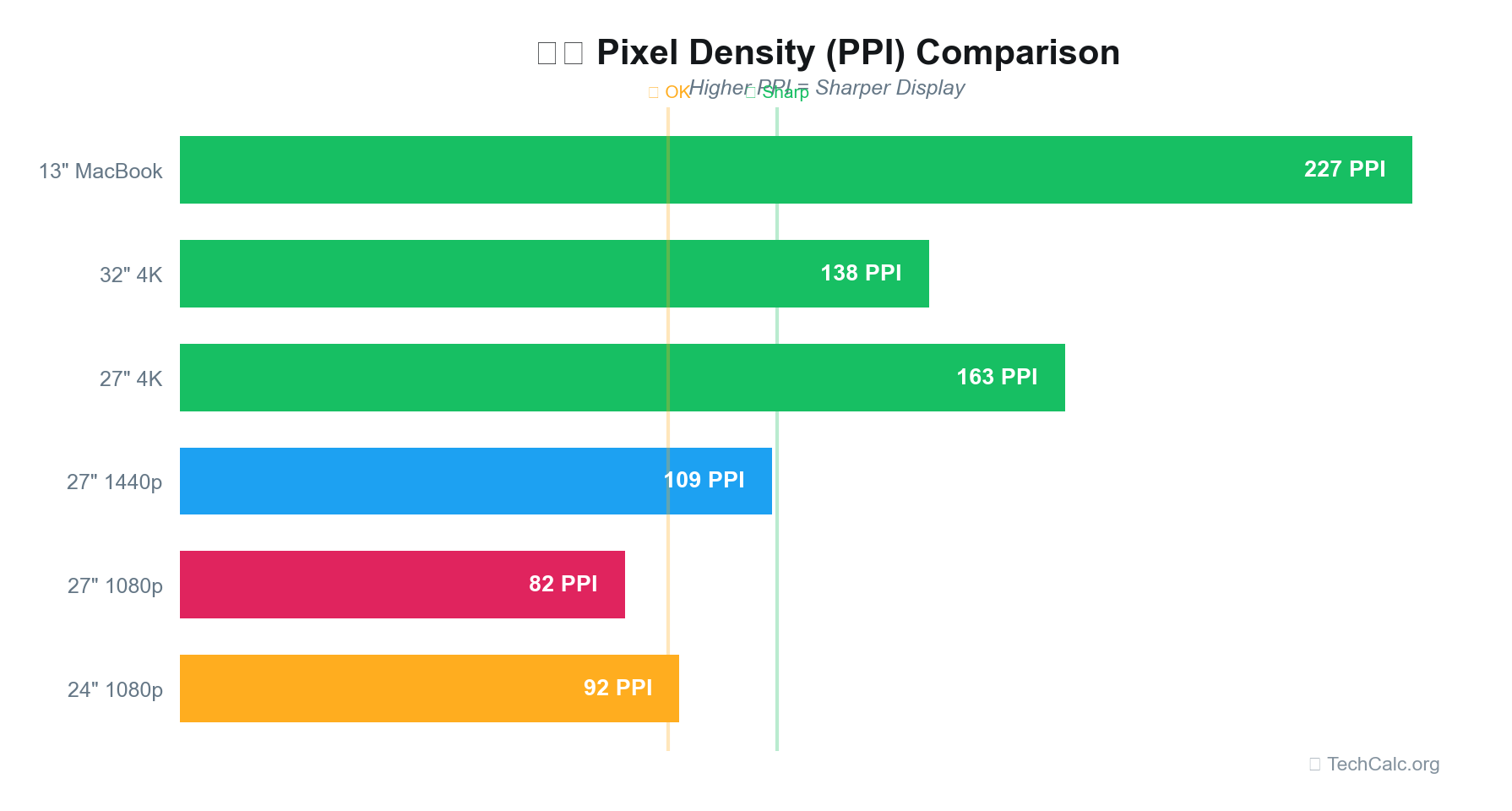
As you can see, while the vertical resolution of 2160 is present in some ultrawide monitors (like the LG 40WP95C-W, though it's IPS, not OLED), a true OLED panel with that exact specification in an ultrawide format is still a frontier. Most of the cutting-edge ultrawide OLEDs opt for 1440 vertical pixels to balance performance, cost, and panel availability.
Is 3440x1440 As Good As 4K?
This is a common question, especially when considering an ultrawide display. The simple answer is no, 3440x1440 is not "as good as" 4K (3840x2160) in terms of raw pixel count. However, whether it's "good enough" or even better for your specific use case is a different story.
Let's break down the numbers:
- 3440x1440: This resolution offers 4,953,600 pixels.
- 3840x2160 (4K): This resolution offers 8,294,400 pixels.
As you can see, a standard 4K display has approximately 67% more pixels than a 3440x1440 ultrawide. This directly impacts pixel density (PPI) and the sharpness of the image, especially on larger screens.
However, 3440x1440 has distinct advantages:
- Performance: Driving 8.3 million pixels (4K) requires significantly more GPU power than driving 4.9 million pixels (3440x1440). For high refresh rate gaming, a 3440x1440 ultrawide often provides a much smoother experience with higher frame rates on the same hardware.
- Field of View: While 4K offers more detail, 3440x1440 ultrawide provides a wider horizontal field of view, which can be more immersive for gaming and beneficial for productivity.
- Cost: Monitors with 3440x1440 resolution are generally more affordable than true 4K displays, especially if we're talking about OLED panels.
Here’s a comparison of pixel counts and typical PPI for different resolutions and screen sizes. You can use our dedicated PPI Calculator to determine the exact pixel density for any screen size and resolution, or even check out our specific page for 4K PPI.
| Resolution (W x H) | Total Pixels | Aspect Ratio | Typical Size | Typical PPI (approx.) | Use Case Considerations |
|---|---|---|---|---|---|
| 1920x1080 | 2,073,600 | 16:9 | 24 inches | 92 PPI | Entry-level gaming, general use. |
| 2560x1440 | 3,686,400 | 16:9 | 27 inches | 109 PPI | Mid-range gaming, good productivity balance. |
| 3440x1440 | 4,953,600 | 21:9 | 34 inches | 110 PPI | Immersive ultrawide gaming, excellent productivity. |
| 3840x2160 (4K) | 8,294,400 | 16:9 | 32 inches | 137 PPI | High detail, professional work, single-monitor desktop. |
| 5120x1440 | 7,372,800 | 32:9 | 49 inches | 109 PPI | Super ultrawide gaming, extreme multi-tasking. |
| 5120x2160 (5K2K) | 11,059,200 | 21:9 | 40 inches | 140 PPI | High-end ultrawide productivity, content creation. |
For many gamers and general users, a 3440x1440 ultrawide OLED offers an incredible experience. The wider field of view often feels more impactful than the higher pixel density of a standard 4K 16:9 monitor, especially when sitting close to the screen. However, for tasks requiring absolute sharp text (e.g., coding, document editing) or fine detail in image/video editing, a true 4K (3840x2160) or even 5K2K (5120x2160) display will offer a noticeable improvement in clarity.
Can an OLED Display 4K?
Absolutely, OLED technology can and does display 4K resolution. In fact, 4K OLED TVs have been mainstream for years, and 4K OLED monitors are becoming increasingly common in standard 16:9 aspect ratios. You can easily find 27-inch, 32-inch, and larger 4K OLED displays that offer stunning picture quality.
The challenge isn't with OLED's ability to display 4K, but rather with producing 4K OLED ultrawide monitor panels. Here's why:
- Manufacturing Complexity: Creating large OLED panels, especially those with non-standard aspect ratios like 21:9 or 32:9, is more complex and expensive than producing standard 16:9 panels. The yield rates for perfect panels can be lower, driving up costs.
- Market Demand vs. Production: While there's certainly enthusiasm for a true 4K ultrawide OLED, the overall market demand for standard 16:9 4K OLED displays (for TVs and gaming monitors) is currently much higher. This incentivizes manufacturers to focus their production lines on these more popular formats.
- Pixel Density vs. Panel Size: To achieve 4K resolution (2160 vertical pixels) on a very wide ultrawide panel (e.g., 40+ inches), the horizontal pixel count becomes extremely high. This pushes the limits of current panel manufacturing techniques while maintaining acceptable pixel density and cost efficiency. For instance, a 40-inch 21:9 ultrawide with true 4K vertical resolution would be around 5040x2160. A 49-inch 32:9 ultrawide with 4K vertical resolution would be a massive 7680x2160. These resolutions require immense processing power and are very challenging to produce in OLED.
So, while OLED is perfectly capable of rendering 4K, the combination with the ultrawide aspect ratio is what makes a true 4K OLED ultrawide monitor a rare and premium product, often appearing in the form of 5K2K (5120x2160) ultrawides, which technically exceed 4K in total pixel count but differ in aspect ratio.
PPI Matters: Why Pixel Density Defines Your Experience
Pixel Per Inch (PPI) is a critical metric that often gets overlooked amidst the hype of "4K" or "ultrawide." PPI tells you how many pixels are packed into every inch of your screen. A higher PPI generally means a sharper, clearer image where individual pixels are less visible.
When you're considering a 4K OLED ultrawide monitor, understanding PPI is paramount. A 34-inch 3440x1440 ultrawide, for example, typically has a PPI of around 110. A 32-inch 4K (3840x2160) monitor, however, has a PPI of about 137. This difference of 27 PPI is noticeable, especially for tasks involving text or fine graphical details.
- Lower PPI: Pixels might be visible, leading to a slightly "screen-door" effect or jagged edges on text and graphics. This can be less noticeable at greater viewing distances.
- Higher PPI: Images and text appear incredibly sharp and smooth, almost like print. This is often preferred for productivity, graphic design, and photo editing.
For ultrawide monitors, the physical size often leads to a lower PPI compared to a standard 16:9 monitor of a similar vertical height. For instance, a 40-inch 5120x2160 ultrawide has a PPI of around 140, which is excellent and comparable to a 32-inch 4K. But a 49-inch 5120x1440 super ultrawide will have a PPI closer to 109, similar to a 34-inch 3440x1440.
Before making a purchase, especially for an expensive display, we highly recommend using our PPI Calculator. Input the exact resolution and screen size of any monitor you're considering to get its precise PPI. This will give you a concrete number to compare and help you visualize the sharpness of the display, ensuring your 4K OLED ultrawide monitor (or high-resolution ultrawide OLED) meets your expectations for visual clarity.
Who Needs a High-Resolution Ultrawide OLED?
A high-resolution ultrawide OLED, whether it's a true 4K OLED ultrawide monitor (if one emerges) or a 5K2K OLED, caters to a specific audience seeking the ultimate visual and immersive experience.
- Enthusiast Gamers: For those with powerful GPUs (e.g., RTX 4080/4090 or RX 7900 XTX) who want the most immersive gaming experience. The ultrawide aspect ratio combined with OLED's instant response times and perfect blacks creates an unparalleled gaming environment, particularly in compatible titles.
- Content Creators (Video Editors, 3D Artists): The expansive screen real estate is invaluable for timelines in video editing software or for simultaneously viewing different panels in 3D modeling applications. OLED's color accuracy and deep blacks are also crucial for grading and visual consistency.
- Productivity Power Users: Professionals who juggle many applications simultaneously, such as financial traders, programmers, or researchers, can benefit from having multiple full-sized windows open side-by-side without the bezels of a multi-monitor setup.
- Media Enthusiasts: For watching movies and TV shows, especially those shot in cinematic aspect ratios, an ultrawide OLED provides an immersive, bar-free viewing experience that's hard to beat.
These monitors are a significant investment, both in terms of cost and the high-end hardware needed to drive them effectively. But for those who demand the absolute best in visual fidelity and screen real estate, the experience can be transformative.
The Future of 4K OLED Ultrawide Monitors (2026 Outlook)
Looking ahead to 2026, the landscape for the 4K OLED ultrawide monitor is poised for continued, albeit gradual, evolution. We're already seeing advancements in panel technology, particularly with QD-OLED, which offers improved brightness and color volume.
Here's what we can expect:
- More 5K2K OLEDs: We anticipate more 21:9 ultrawide OLEDs with 5120x2160 resolution. These are the closest to a "true" 4K ultrawide in terms of vertical pixel count and overall pixel density, offering a fantastic balance of immersion and sharpness.
- Larger QD-OLED Ultrawides: Expect larger diagonal sizes for QD-OLED ultrawides, possibly pushing beyond 34-inch and 49-inch with resolutions like 5120x1440 or even higher.
- Increased Refresh Rates: As display port standards evolve (e.g., DisplayPort 2.1), higher refresh rates at these demanding resolutions will become more common, benefiting competitive gamers.
- Improved Brightness and Burn-in Resistance: OLED technology is continually improving. Future panels will likely boast higher peak brightness levels and enhanced resistance to burn-in, addressing some of the historical concerns.
- Price Adjustments: While always premium, increased competition and manufacturing efficiencies may lead to slight price reductions over time, making these monitors more accessible to a broader audience.
The dream of a truly standardized 4K (3840x2160 equivalent) ultrawide OLED might still be a few years out, but the current generation of high-resolution ultrawide OLEDs, especially those with 5K2K or advanced QD-OLED 3440x1440 panels, offers an incredibly compelling experience that is continuously improving.
Conclusion
The quest for the perfect 4K OLED ultrawide monitor is an exciting journey through cutting-edge display technology. While a traditional 3840x2160 resolution in an ultrawide format remains elusive, the market is rich with high-resolution ultrawide OLED options that deliver stunning visuals, incredible immersion, and superior performance. Whether you opt for a 3440x1440 QD-OLED for gaming or a 5120x2160 IPS ultrawide for productivity, understanding the nuances of resolution, aspect ratio, and pixel density is key. Always use tools like our PPI Calculator to make an informed decision, ensuring your next display truly elevates your computing experience.